
Design your photo book using conversational AI
Photo 9
13 min read · June 22, 2026
Design your photo book using conversational AI
Creating a photo book should feel like reliving your favorite moments, not managing a complicated design project. Yet for many families, couples, travelers, parents, and gift buyers, the old process still means endless scrolling, manual sorting, awkward drag-and-drop editing, and hours spent second-guessing layouts.
That is exactly why conversational AI changes the game.
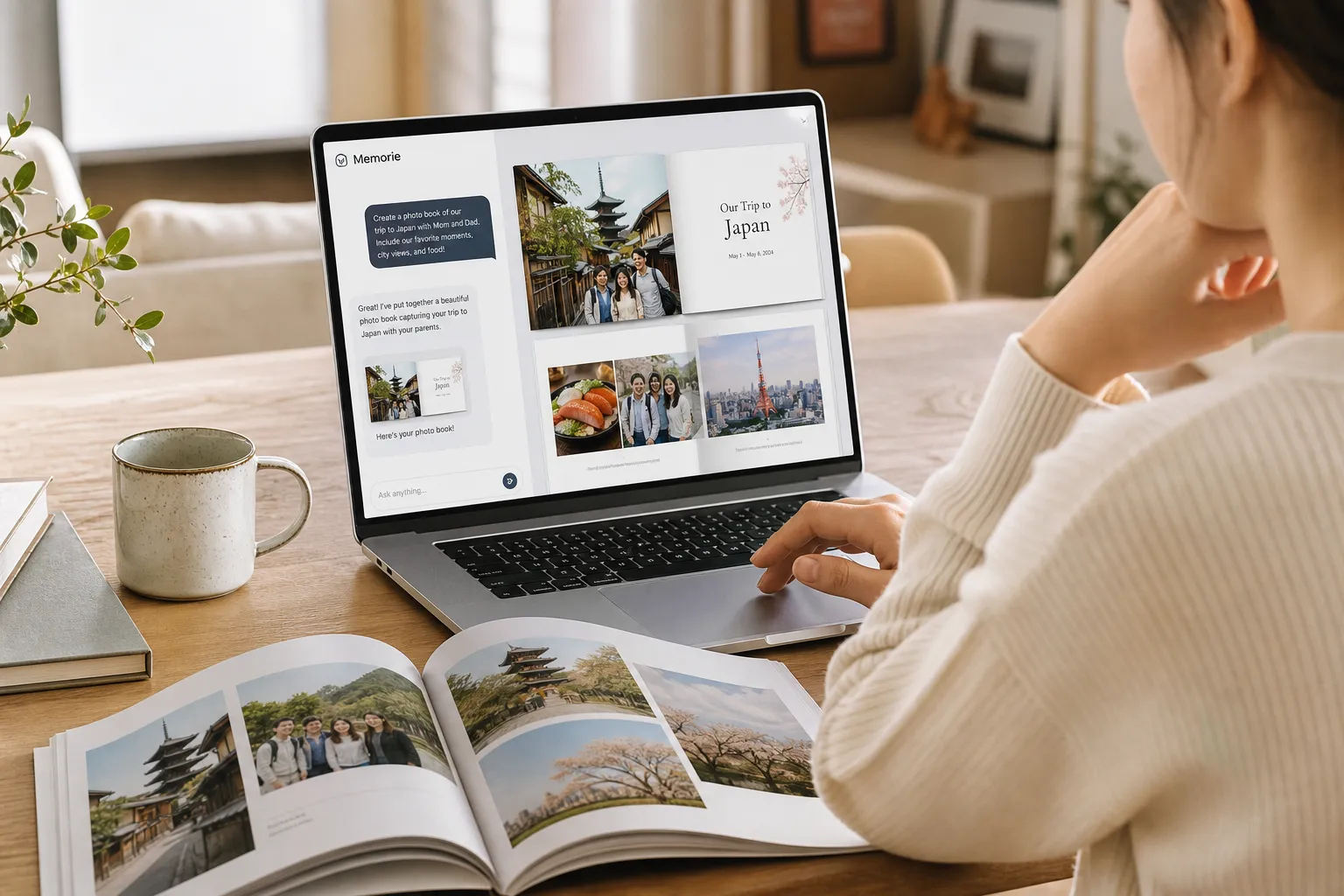
Instead of learning complex software, you can simply describe what you want in plain English: “Make this feel warm and elegant,”“Put the beach photos first,” or “Add more space for captions around the kids’ birthday pictures.” Your photos fall into place, the pacing improves, and the design starts looking polished in minutes, not days.
At Photo9, we believe the era of complex tools is over. Our platform helps you turn digital memories into premium photo books and wall art through AI-generated layouts, smart suggestions, easy browser-based editing, and full customization across devices. No app. No design experience. No wasted evenings moving images around pixel by pixel.
Why conversational AI is the easiest way to design a photo book
The biggest shift is simple: you no longer need to “design” in the traditional sense.
Instead of opening a blank canvas and making hundreds of tiny decisions, conversational AI lets you communicate the outcome you want. That makes it ideal for busy people who still care deeply about preserving memories well.
What conversational AI actually does
A strong AI photo book experience should do more than place images on pages. It should help with:
sorting photos into a natural sequence
recognizing visual patterns and grouping moments together
suggesting layouts based on the number, orientation, and mood of your images
balancing close-ups, landscapes, details, and text moments
adapting styles through simple prompts
making revisions without forcing you to start over
At Photo9, the process feels more like directing than designing. You tell the platform what you want, and the AI handles the heavy lifting behind the scenes.
Why this matters for real people, not just designers
Most people do not want “creative control” over every millimeter of a page. They want a beautiful result with the option to personalize key details. That is a major difference.
Whether you are making a wedding album, a family yearbook, a baby memory book, or a travel keepsake, conversational AI reduces the friction between having the photos and actually turning them into something physical.
"Personalized gifts are perceived as 4.2 times more memorable than generic ones, with 72% of recipients describing them as their favorite gifts of the year." - Amour Print
That stat helps explain why photo books remain such powerful gifts: they are personal, emotional, and lasting. AI simply removes the tedious part that used to stop people from creating them.
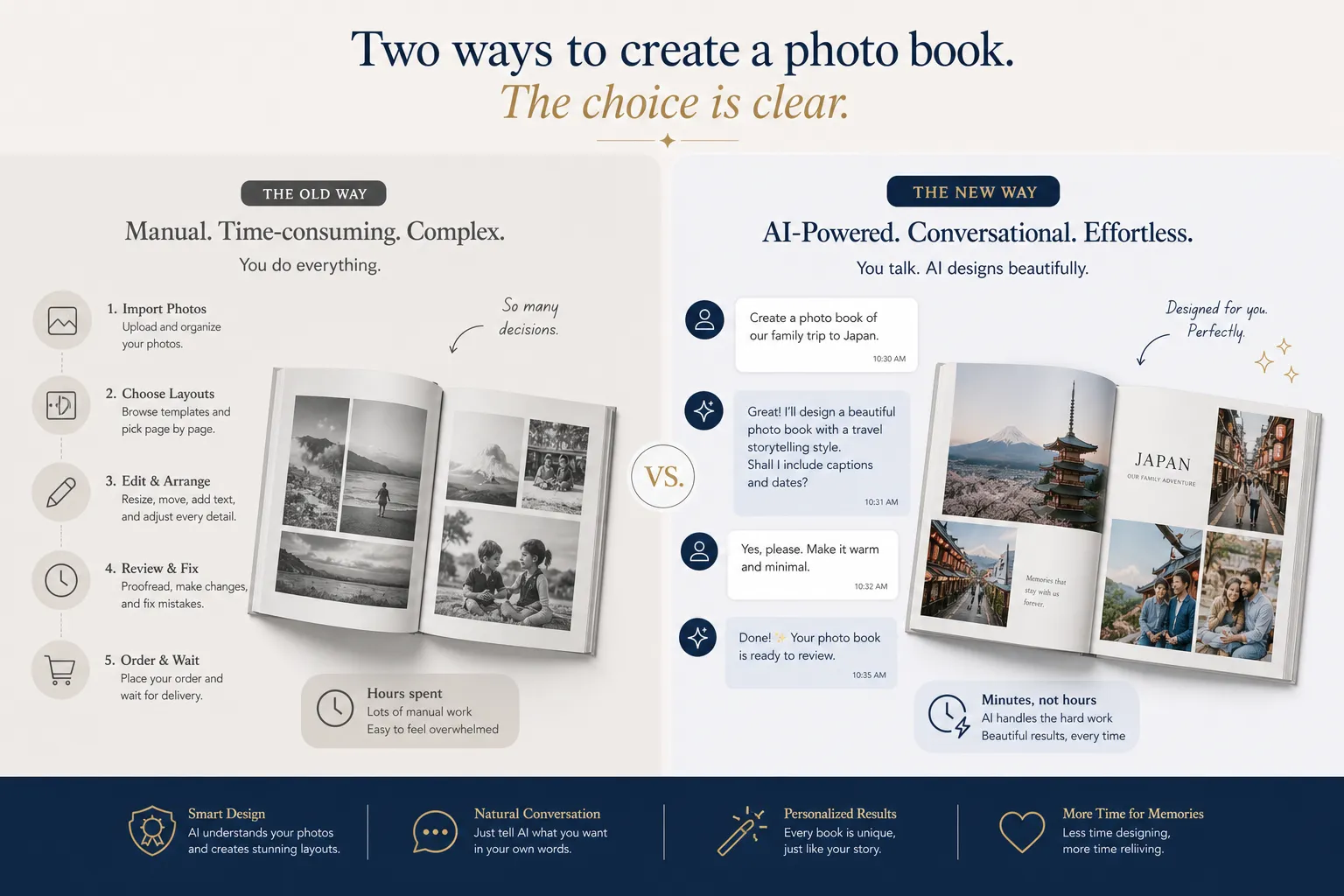
The old way vs the conversational AI way
Here is the clearest way to understand the difference.
Task | Traditional photo book tools | Conversational AI with Photo9 |
|---|---|---|
Getting started | Begin with a blank template | Start with a simple prompt |
Photo selection | Manual sorting and reordering | Smart layout suggestions and automated structure |
Design decisions | You choose every layout by hand | AI generates polished layouts in seconds |
Revisions | Often slow and repetitive | Ask for changes in plain English |
Learning curve | Can feel technical and time-consuming | No design experience required |
Device flexibility | Sometimes desktop-heavy or app-dependent | Cross-device access in your browser |
Confidence before ordering | Limited sense of final result | 3D preview before you buy |
What top-ranking articles get right, and what they usually miss
Most high-ranking content around AI photo books focuses on the same benefits:
speed
convenience
automated layouts
template variety
personalization after AI creates a first draft
premium printing and gift potential
Those are important, but many articles stop there. They explain what AI does, but not how people actually want to use it.
The biggest content gaps in most competitor articles
After reviewing the patterns in leading pages, several gaps stand out:
1. They talk about automation, but not conversation
Many competitors mention AI-generated books, but few explain the real breakthrough: being able to guide the design in natural language. That is what makes AI feel usable to everyday people.
2. They do not explain the emotional workflow
A photo book is not just a product. It is often a project tied to love, grief, travel, parenthood, milestones, or gifting. Good design tools should reduce overwhelm, not add to it.
3. They underplay the “no app” advantage
Modern users switch between phone, laptop, and tablet constantly. A browser-based, cross-device solution matters far more than many articles admit.
4. They mention customization, but not intelligent customization
There is a difference between “you can edit the book” and “the system helps you make better edits.” Smart suggestions, AI descriptions, prompt-based changes, and visual previews are where the real value lives.
5. They rarely connect speed with quality
Fast often sounds cheap. The best experience is fast and premium: professional-looking layouts, quality paper, sustainable materials, secure payment, reliable shipping, and satisfaction guarantees.
How Photo9 makes conversational photo book design feel effortless
Photo9 was built for people who want beautiful printed memories without learning design software.
Start with a prompt, not a template problem
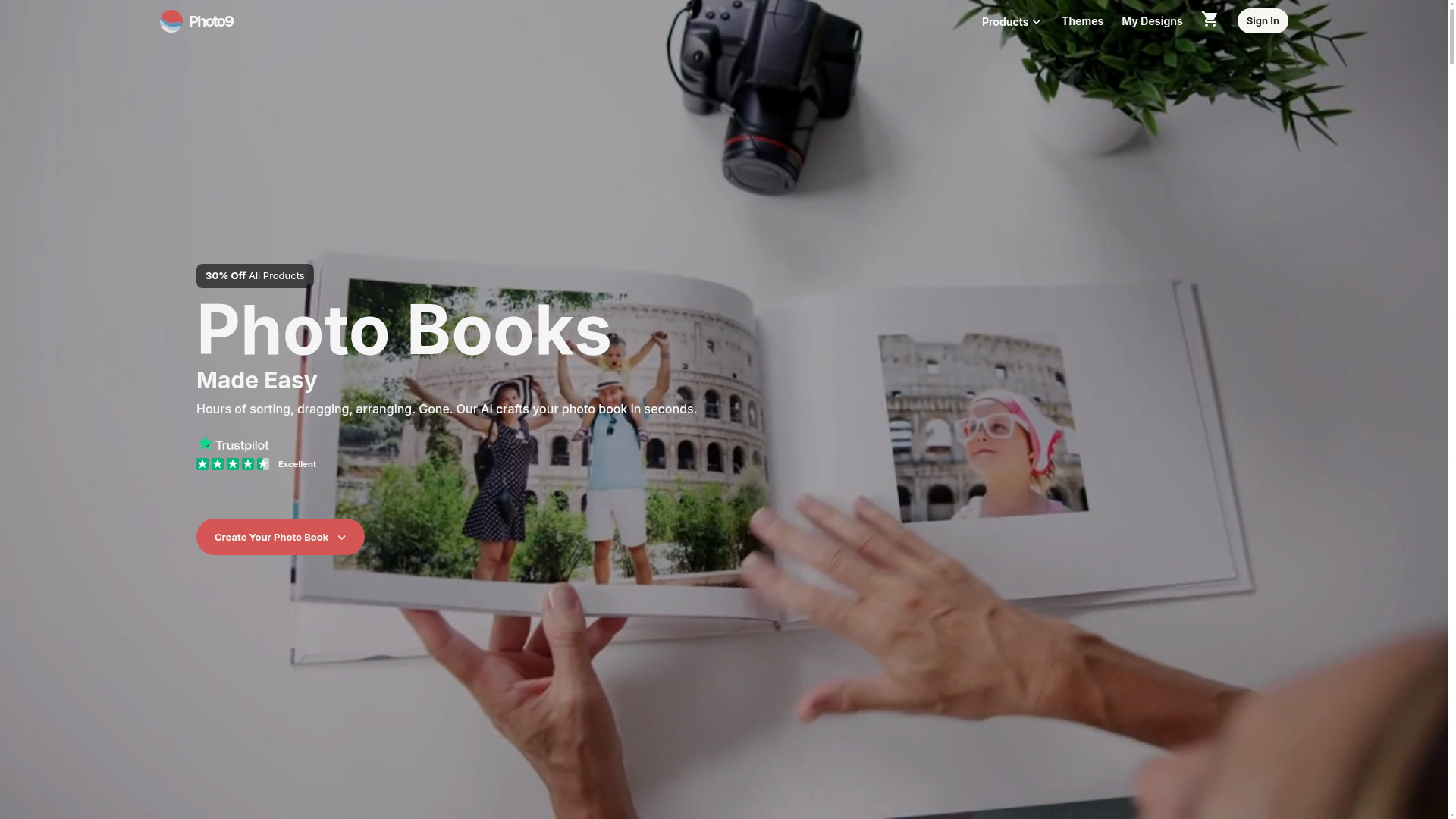
Instead of wrestling with layout tools, you can simply describe your intent. For example:
“Make this a clean, modern travel book.”
“Focus on family moments and keep the colors soft.”
“Use more full-page photos for the wedding ceremony.”
“Add room for short captions and dates.”
“Make the cover more elegant and less playful.”
That changes the entire experience. It feels intuitive because it matches how people naturally think.
If you want more inspiration before you start, explore Photo9’s guide to make photo books with AI.
AI-generated layouts in seconds
Photo9 automatically creates strong page compositions based on your photos. It considers image orientation, spacing, storytelling flow, and overall visual balance, then presents a polished starting point almost instantly.
This is where many users save the most time. Instead of spending hours placing pictures manually, they can review, tweak, and personalize a design that is already well on its way.
Fully customizable when you want control
AI should never trap you in a draft you do not love. With Photo9, you can refine the result through:
text and captions
backgrounds and visual styles
page order
image replacements
layout variations
prompt-based edits
product and format choices
So the process feels fast without feeling generic.
Professional design without professional skills
One of the biggest barriers to ordering a photo book is fear: What if it looks amateur?
Photo9 is designed to remove that anxiety.
The AI helps deliver polished pacing, consistent styling, and more editorial-looking pages, even if you have never designed anything before.
3D preview before you order
Seeing flat pages is useful. Seeing the actual book experience is better.
Photo9’s 3D preview helps you understand how the finished product will look in your hands, which builds confidence before purchase and reduces surprises.
Who benefits most from conversational AI photo book creation
This kind of workflow is especially valuable for people who care about memories but do not have time to build books from scratch.
Families and parents
From yearly family albums to milestone books for babies and children, parents often have the most photos and the least time. AI can quickly organize the chaos into something meaningful.
If you are planning a yearly keepsake, a year in review photo book is one of the easiest formats to create with AI because the storytelling structure is already built into the year.
Couples and wedding customers
Wedding and anniversary books need elegance, pacing, and emotional rhythm. Conversational AI helps make the layout feel intentional while still leaving room for personal notes, vows, or dates.
Travelers
Travel books benefit enormously from automation because trips usually involve many images across locations, landscapes, meals, details, and people. AI can help create a more story-driven flow instead of a random photo dump.
Students and friends
Graduations, friend groups, exchange programs, birthdays, and shared trips make ideal memory books. These are often emotional gift products where speed matters because dates and deadlines are fixed.
Gift buyers
When you are short on time but want to give something truly personal, conversational AI is one of the fastest paths from photo library to meaningful printed gift.
How to use natural language prompts for better photo book results
The quality of the first draft often improves when your prompts are specific but simple.
Best prompt ingredients
Include one or more of these:
the mood: warm, elegant, playful, minimal, nostalgic
the purpose: birthday gift, wedding album, baby book, vacation keepsake
the pacing: more full-page images, more collages, more white space
the text style: captions only, storytelling paragraphs, date-based notes
the visual preference: clean, colorful, timeless, magazine-style
Example prompts you can actually use
“Create a soft, timeless baby book with space for milestones and captions.”
“Design a bold travel photo book with energetic layouts and map-like pacing.”
“Make this anniversary book elegant, romantic, and minimal.”
“Use a modern family yearbook style with simple captions and bright pages.”
“Turn these birthday photos into a playful gift book with colorful backgrounds.”
What to avoid
Avoid prompts that are too vague, such as:
“Make it nice.”
“Do something cool.”
“Just arrange everything.”
Those can still work, but better inputs usually create stronger first drafts.
What makes a great AI photo book beyond speed
Speed gets attention, but quality earns trust.
Premium materials matter
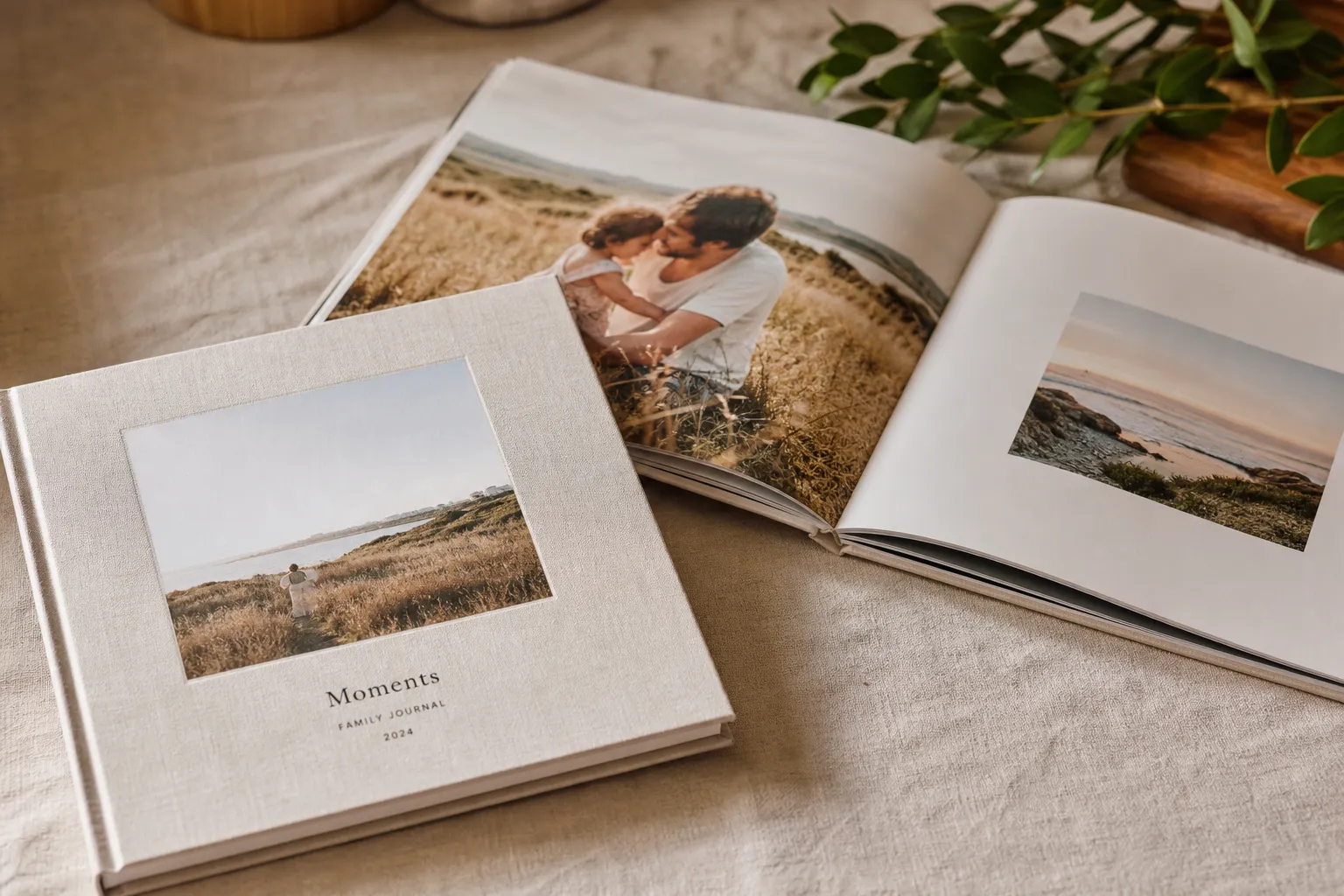
A photo book is meant to be held, gifted, revisited, and displayed. That means material quality matters as much as software quality. Photo9 emphasizes premium print results, with strong paper and finish choices that make the book feel substantial and gift-worthy.
Sustainable production matters too
Customers increasingly want printed products that feel responsible, not wasteful. Photo9 supports local printing when possible, lower-emission production choices, sustainable materials, FSC-certified paper options, and recyclable packaging.
"Among consumers aware of FSC, 62% prefer choosing FSC-certified products over non-certified equivalents." - FSC
That is not just a sustainability talking point. It is a trust signal for modern buyers.
Delivery, payment, and confidence matter at checkout
Great creation tools are only half the experience. The other half is fulfillment. Photo9 supports secure payment, fast and reliable delivery, and a 100% satisfaction guarantee, which is especially important for gifts tied to birthdays, weddings, holidays, and anniversaries.
Photo9 formats and product flexibility
Not every memory belongs in the same format.
Photo books in multiple formats and themes
Different moments call for different types of books. Photo9 supports multiple sizes, styles, and use cases so the format can match the story.
You can explore options like hard cover photo books for milestone events and premium gifting, or choose lighter formats for more casual projects and everyday memory keeping.
Wall art for memories that deserve display space
Some images do not belong in a book at all. They belong on the wall.
Photo9 also offers wall art formats like canvas, forex, and posters, making it easy to turn standout photos into home décor or gifts. That is especially useful for wedding portraits, family images, nursery art, travel landscapes, or milestone photos.
One platform, multiple outcomes
What makes this especially useful is that you can work from one photo collection and one creative workflow, then choose the final format that fits the purpose best.
A simple step-by-step workflow for designing a photo book with conversational AI
Here is what the process should look like when it is truly user-friendly.
1. Upload your photos
Start from your phone, laptop, or tablet. Bring in the images that matter most.
2. Tell the AI what you want
Describe the occasion, mood, and style in natural language.
3. Review the generated layout
Let the AI build a first version in seconds.
4. Personalize the details
Add text, adjust backgrounds, swap images, or request style changes through prompts.
5. Preview in 3D
Check the flow, cover, pacing, and overall feel before ordering.
6. Print with confidence
Choose your preferred format, complete secure checkout, and let Photo9 handle the rest.
Common concerns people have before using AI for a photo book
“Will it feel generic?”
Not if the system is built well and you personalize it thoughtfully. AI gives you a strong structure, but your photos, captions, story, and preferences are what make the result unique.
“Do I lose control?”
No. The best conversational AI tools speed up the tedious parts while keeping your final say on photos, text, style, and layout.
“What if I am not creative?”
That is exactly who this experience is for. You do not need design skills to create something beautiful when the platform offers smart layouts, prompt-based guidance, and a polished starting point.
“Can I use it without downloading anything?”
Yes. A browser-based system is one of the biggest practical advantages because it keeps the experience accessible across devices.
“Will the final print actually look premium?”
That depends on the provider. With Photo9, the goal is not just convenience but high print quality, strong materials, dependable fulfillment, and a product you will genuinely want to keep or give.
Final verdict: conversational AI is not a gimmick, it is the better workflow
Designing a photo book using conversational AI is not about replacing creativity. It is about removing friction.
You still choose the memories. You still shape the tone. You still decide what deserves to be printed, gifted, displayed, or saved for the next generation. What changes is the process: instead of struggling through slow, manual design tools, you can move from idea to finished product with clarity, speed, and confidence.
That is where Photo9 stands out.
With AI-generated layouts in seconds, simple prompt-based editing, no-app browser access, cross-device flexibility, customizable photo books and wall art, 3D preview, premium materials, sustainable production choices, secure payment, fast delivery, and a 100% satisfaction guarantee, Photo9 turns photo printing into something modern and human again.
If you are ready to stop organizing memories the hard way and start creating them beautifully, Photo9 is the smartest place to begin.
FAQ
How to create a photobook using AI?
Start by uploading your photos and telling the AI what you want in plain English, such as the mood, occasion, or layout style. The AI generates a draft in seconds, and you can then refine it with captions, backgrounds, image swaps, and prompt-based edits before previewing and ordering.
Is Mixbook free?
Many photo book platforms let you design for free and only charge when you order a printed product, but pricing and features vary by provider. If you want a streamlined alternative, Photo9 focuses on AI-assisted creation, easy browser-based editing, and premium print quality without the complexity of traditional design tools.