
Photo9 Conversational AI for Print-on-Demand E-Commerce Photobooks and wallart
Photo 9
14 min read · June 23, 2026
Photo9 Conversational AI for Print-on-Demand E-Commerce Photobooks and Wall Art
If you love the idea of turning memories into something physical but hate the usual process of sorting, dragging, cropping, arranging, and second-guessing every page, conversational AI changes everything.
Traditional photobook tools often make people feel like they need to become part designer, part editor, and part production manager just to create one meaningful gift. That friction is exactly where many memory projects die. The photos stay on a phone. The album never gets made. The gift idea stays an idea.
Photo9 takes a very different approach. Instead of making you learn software, it lets you describe what you want in natural language. You can ask questions, get product recommendations, organize photos, generate layouts in seconds, request edits through prompts, preview the result in 3D, and move all the way through ordering and delivery support in one guided flow. In other words, this is not just AI for page layouts. It is conversational AI for the full end-to-end customer journey.
"In 2023, approximately 1.8 trillion photos were taken worldwide, with 92.5% captured using smartphones." - PetaPixel
For families, parents, couples, wedding customers, travelers, students, friends, and gift shoppers, that matters. We have more memories than ever, but less time than ever to do something beautiful with them.
Why conversational AI is the next step for photo books
Most AI photobook tools today focus on one thing: auto-layouts. That is useful, but incomplete.
The real challenge is broader. Customers do not just need help placing photos on pages. They need help with:
choosing the right product
understanding hardcover vs softcover
deciding which format suits the occasion
knowing how many photos to upload
getting a clean first design
editing without learning complex tools
feeling confident before payment
understanding shipping and delivery
trusting the final print quality
This is why conversational AI is so powerful. It behaves more like a helpful advisor than a feature buried inside an editor.
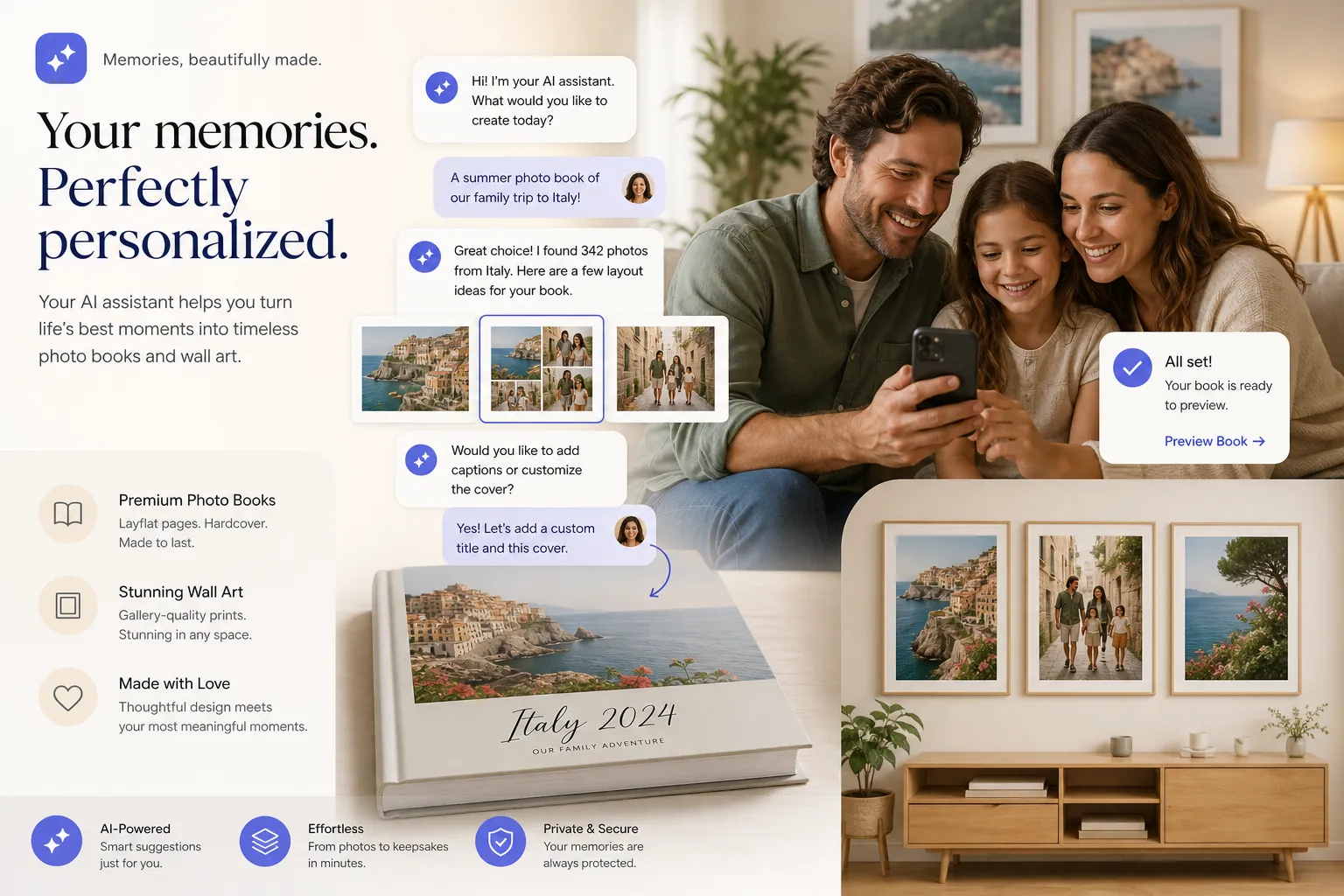
With Photo9, the experience becomes much more human:
“I want to make a wedding album that feels elegant.”
“Can you turn these travel photos into a modern hardcover book?”
“Use fewer images per page and add short captions.”
“What’s the best option for a birthday gift?”
“Can I make matching wall art from my favorite spread?”
That shift matters because people do not naturally think in templates, bleed areas, or layout grids. They think in memories, occasions, gifts, moods, and stories.
What top-ranking competitors get right - and what they still miss
After analyzing competitor content across print-on-demand, photobook, and AI-assisted creation pages, a few common strengths stand out.
What competitors usually explain well
Common theme | Why it works |
|---|---|
AI can speed up photobook creation | Readers want convenience |
Automatic layouts save time | This directly addresses friction |
Print quality matters | Buyers want confidence before ordering |
Customers still want customization | AI should assist, not fully replace taste |
Different book formats matter | Occasion-based buying is real |
The content gaps most competitors leave behind
What they often miss | Why it matters |
|---|---|
The full discovery-to-delivery journey | Users need help before and after design, not only during layout |
Natural-language editing | Prompt-based changes are easier than manual design tools |
Product recommendation inside the AI flow | Buyers often do not know what to choose |
Shipping, checkout, and post-purchase assistance | Trust increases conversions |
Cross-device use without an app | Busy users want flexibility |
Matching products beyond photobooks | Memory buyers often want wall art or gifts too |
This is where Photo9 has a real advantage. It is built around the entire journey, not a single design step.
What Photo9 conversational AI actually does
Photo9 Conversational AI transforms a traditionally complex creation flow into a guided, prompt-based experience.
It answers product and pricing questions
Instead of hunting through menus, users can ask direct questions:
Which format is best for a wedding?
Is a hardcover worth it for a family yearbook?
What size works best for travel photos?
Which option feels most giftable?
That reduces hesitation early in the funnel and helps users move forward with confidence.
It recommends the right product format
Not every memory belongs in the same product. A baby milestone album might suit a premium hardcover. A casual holiday recap may fit a softcover. A standout portrait might work better as wall art than inside a book.
Photo9 can help users discover those options naturally while exploring AI photo book formats, rather than forcing them to decode product pages alone.
It organizes uploaded photos
One of the biggest pain points in photobook creation is not design. It is chaos.
Users often upload:
duplicates
screenshots
similar-looking shots
mixed orientations
detail shots with no clear sequence
hundreds of images with no obvious story flow
Photo9 helps make sense of that material fast, so the project starts with momentum instead of overwhelm.
It designs complete books automatically
This is where Photo9’s AI-generated layouts in seconds become especially valuable. The system can assemble a polished first draft that feels coherent, balanced, and ready to refine.
For people who have delayed a memory book for months, this is often the breakthrough moment.
It allows prompt-based editing
This is the feature that turns “AI layout tool” into “conversational creation experience.”
Instead of manually changing dozens of controls, users can simply say:
Make this cleaner and more minimal
Add space for captions
Move the beach photos toward the beginning
Use larger images on the first few pages
Make it feel more emotional and gift-worthy
That makes design far more accessible for people with no formal design experience.
It helps generate captions and intro text
Many people want their books to feel personal but struggle to write page text or introductions. Conversational AI can help create a warm first draft for captions, titles, and memory notes that users can keep, edit, or replace.
If text matters in your design, it also helps to understand common layout pitfalls in photo books that allow text.
It supports checkout, shipping, and delivery questions
The customer journey does not end when the design is done.
Users still want reassurance about:
secure payment
delivery timelines
production quality
shipping status
order confidence
Photo9’s conversational approach extends into these stages too, creating a smoother e-commerce experience overall.
From discovery to delivery: the end-to-end AI journey
Here is what makes Photo9 different from standard print-on-demand editors: it supports the full journey.
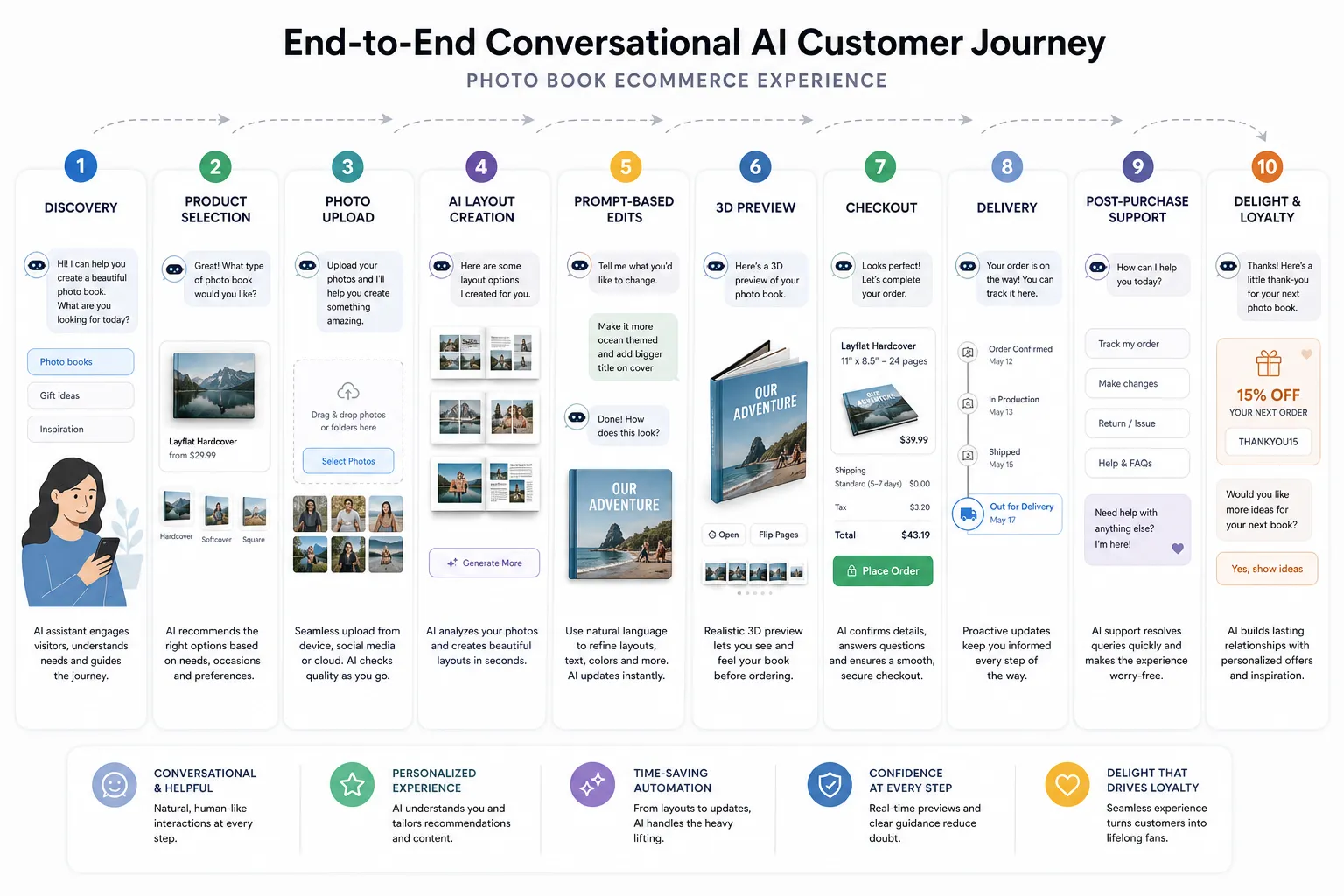
1. Discovery
The customer arrives with a vague goal:
“I want to preserve our trip”
“I need a meaningful birthday gift”
“I want something special from our wedding photos”
The AI helps translate that emotional intent into a product direction.
2. Product selection
The assistant explains options such as hardcover, softcover, themes, sizes, and use cases. It can suggest what works best for a gift, a family keepsake, or a premium coffee-table book.
For shoppers who want a more elevated finish, a hardcover photo book is often the strongest choice for milestone memories.
3. Design from scratch
Users upload images and receive a complete first version quickly. No blank canvas. No manual page-building from zero.
4. Editing by conversation
Instead of learning complicated software, the customer edits through prompts and simple choices. That means less effort, fewer abandoned sessions, and more confidence.
5. Preview
Photo9 offers 3D preview and smart layout suggestions so users can evaluate the book visually before they buy. This is crucial for trust.
6. Ordering
The checkout experience supports secure payment and clear next steps, making the leap from “I made something” to “I ordered it” feel easy.
7. Shipping and delivery
Fast and reliable delivery matters even more when products are purchased as gifts. Photo9 supports local printing when possible, helping lower emissions while also improving delivery efficiency.
8. Post-purchase potential
A finished photobook can become the start of a broader memory collection. One favorite image might become canvas, forex, or poster wall art. More product categories are also expected as the platform grows, making the conversational engine even more useful over time.
Why this matters for print-on-demand e-commerce
Conversational AI is not just a user-experience upgrade. It is a business upgrade.
Higher conversion potential
When a customer can ask questions naturally, understand products faster, and create something polished without frustration, fewer people drop off.
"Approximately 80% of consumers worldwide are comfortable with personalized experiences and expect companies to offer them." - Boston Consulting Group
That expectation applies directly to photo commerce. People increasingly want products tailored to their story, not generic mass-market goods.
Lower creative friction
The biggest hidden enemy in print-on-demand is hesitation. If creation feels too hard, people leave. Photo9 reduces this by replacing manual complexity with guided simplicity.
Stronger emotional outcomes
Photobooks and wall art are not impulse gadgets. They are emotional products. A better creation flow increases the chance that users finish something they truly care about.
Better fit for modern users
Busy, digital-first customers want:
no app required
fast results
cross-device access
simple customization
premium output
sustainability they can feel good about
Photo9 aligns with all of those expectations.
Photo9 versus traditional photobook creation
Here is a practical comparison.
Feature | Traditional photobook software | Photo9 conversational AI |
|---|---|---|
Starting point | Blank editor | Guided conversation |
Product discovery | Manual browsing | AI recommendations |
Photo organization | Mostly manual | AI-assisted sorting |
Layout creation | Drag-and-drop | AI-generated layouts in seconds |
Editing | Tool-based | Prompt-based |
Text help | Manual writing | AI-assisted captions and intro text |
Device access | Often app-led or limited | Browser-based and cross-device |
Preview confidence | Basic preview | 3D preview and smart suggestions |
Checkout support | Separate from design | Part of the overall guided journey |
Sustainability | Varies | Local printing, sustainable materials, recyclable packaging |
Who benefits most from conversational AI photobook creation
Families and parents
Busy families often have thousands of images and little time. AI helps turn school memories, holidays, birthdays, and everyday moments into something real without an hours-long project.
New parents
Baby books are deeply emotional, but early parenthood is not exactly a season of spare time. A conversational system makes it easier to finish the keepsake instead of postponing it forever.
Couples and wedding customers
Wedding albums need polish and emotional pacing. AI can accelerate the structure while leaving room for personal edits.
Travelers
Trips generate huge, messy photo libraries. Conversational AI helps shape them into a story rather than a random archive.
Gift buyers
A personalized photobook or wall print feels more meaningful than a generic gift, especially when it can be created quickly and still look professionally designed.
Students and friends
Graduation books, group memory books, and friendship keepsakes often involve many contributors and scattered photos. AI helps unify them into one cleaner result.
Why Photo9 feels different in practice
The difference is not just that Photo9 uses AI. It is how naturally the experience fits real behavior.
No app required
You can create directly in the browser, which lowers friction immediately.
Cross-device access
Start on one device, continue on another. That matches the way people actually live and shop.
Professional design without design experience
Users do not need to understand page composition, hierarchy, or print setup to get a polished result.
Fully customizable results
AI gets you started fast, but the book still becomes yours. You can refine text, images, backgrounds, pacing, and emphasis.
Multiple product formats and themes
Photo9 supports multiple photobook styles and wall art possibilities, with more products expected in the future as the platform expands.
Premium materials and high print quality
Speed matters, but quality matters more. Photo9 pairs convenience with premium output so the final product feels worthy of gifting, displaying, or keeping for years.
Fast delivery and secure payment
Trust is essential in any e-commerce experience, especially when people are buying sentimental products online.
Sustainability built in
Local printing when possible, sustainable materials, and recyclable packaging help make memory products feel more responsible, not more wasteful.
How to get the best results with conversational AI
Even with a strong AI assistant, a few simple habits improve the final book.
Be clear about the occasion
Tell the AI whether this is a travel story, anniversary gift, baby book, birthday surprise, or year-in-review album. Context improves recommendations.
Upload generously
Do not over-filter too early. Give the system enough variety to build pacing and contrast.
Ask for mood, not just mechanics
Instead of only saying “change layout,” try prompts like:
make it feel more elegant
make this more playful
create a premium gift look
keep it minimal and modern
Edit the emotional highlights
AI can do the heavy lifting, but you should still spotlight the most meaningful images and moments.
Always use the preview
3D preview is where confidence is built. It helps catch pacing, cropping, and text issues before you order.
The future of AI in memory products
The next wave of AI in print-on-demand will not be about isolated tools. It will be about connected experiences.
Instead of separate steps for discovery, design, editing, and ordering, the best platforms will blend them into one conversation. That is where Photo9 is already moving.
This matters not just for photobooks, but for the broader world of personalized physical products:
wall art
gift collections
seasonal keepsakes
occasion-based memory products
future print formats still to come
As more product categories arrive, the value of a conversational layer will only grow. The customer will not need to learn new workflows for each new product. They will simply describe what they want.
Final verdict: is conversational AI the future of photobooks and wall art?
Yes - especially for people who want beautiful results without design stress.
The strongest AI tools in this category will not just automate layouts. They will guide the entire journey from first idea to finished order. That is the real leap Photo9 makes.
It helps customers discover the right product, understand materials and formats, organize photos, generate layouts in seconds, refine the design through natural language, preview it confidently, pay securely, and receive a premium product with fast, reliable delivery. Add in local printing, sustainable materials, recyclable packaging, and the flexibility of browser-based creation, and the result is a much more complete experience than traditional photobook software.
If your photos deserve more than living in a camera roll, Photo9 gives you a smarter, faster, and more human way to turn them into something worth holding, gifting, or hanging on the wall.
FAQ
Can I use AI images for print on demand?
Yes, you can use AI-generated images for print on demand, as long as you have the right to use them and they meet the platform’s quality standards. Photo9 goes even further by combining AI with your own memories, helping turn personal photos into print-ready books and wall art through a conversational workflow.
What is the most profitable print on demand sites?
The most profitable print-on-demand sites are usually the ones that combine strong personalization, premium products, and an easy buying journey. For memory-based products like photobooks and wall art, platforms such as Photo9 stand out because they reduce creation friction and help more users finish and order meaningful products.
What is the best print on demand site for books?
If you want personalized books built from your own photos, the best option is a platform that offers AI-assisted design, premium print quality, and easy ordering. Photo9 is especially strong because it supports the full journey, from product selection and prompt-based editing to 3D preview, checkout, and delivery.
Can you sell art created by ChatGPT?
You may be able to sell AI-created art, but you should always check the usage rights, originality, and platform policies involved. In the print-on-demand space, it is safest to use content you have permission to commercialize and to make sure the final files are suitable for high-quality printing.
What is the best AI for print-on-demand?
The best AI for print-on-demand is one that does more than generate images or layouts. Photo9 is a strong example because it offers conversational AI across the whole customer journey - helping with discovery, product recommendations, book design, edits, preview, ordering, and support in one smooth experience.