
Travel Photo Book Inspiration Ideas to Treasure
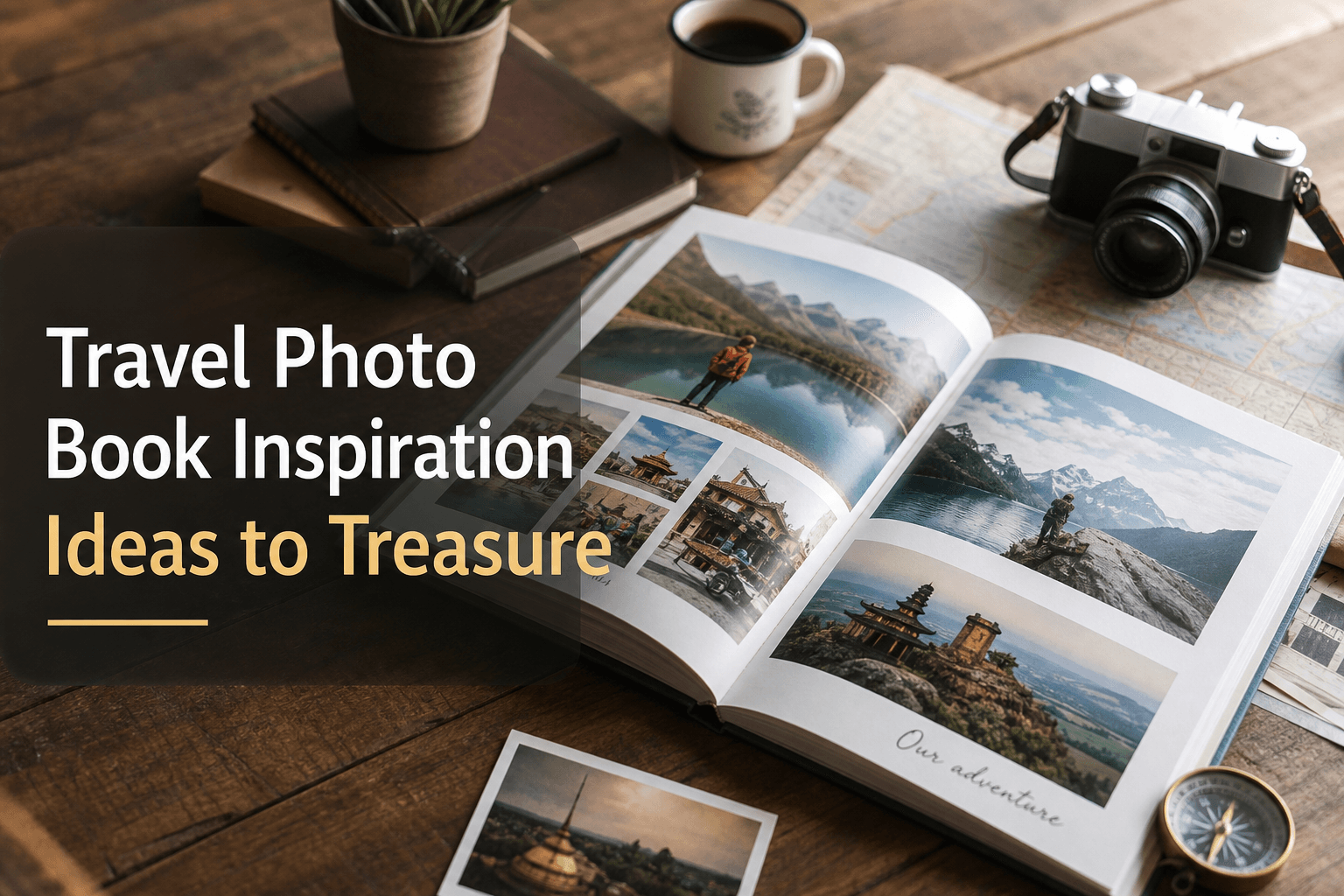
Photo 9
13 min read · May 28, 2026
Travel Photo Book Inspiration Ideas to Treasure
A great trip deserves more than a camera roll full of forgotten images. If you’re searching for travel photo book inspiration, chances are you want a beautiful way to turn scattered holiday snapshots into something you can hold, share, gift, and revisit for years.
The challenge is rarely the memories themselves. It’s the process. Too many travelers get stuck choosing photos, building layouts, writing captions, and making everything look polished. That’s exactly where Photo9 changes the experience. Instead of spending hours dragging and dropping images, you can create a professional-looking travel photo book in minutes with AI-generated layouts, smart design suggestions, easy text editing, and a 3D preview you can review from any device.
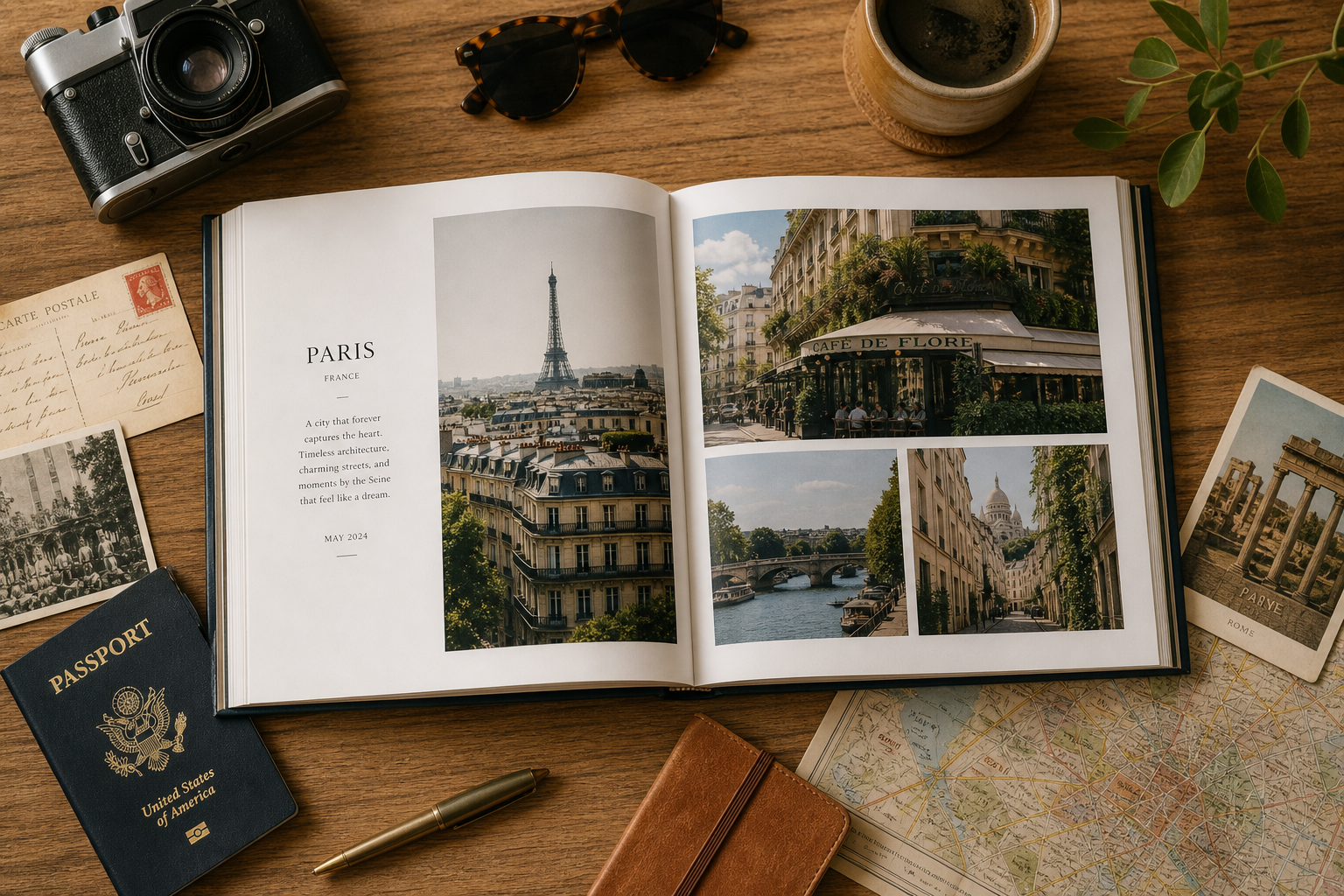
More importantly, a travel photo book becomes more than a product. It becomes your story: the missed trains, perfect sunsets, tiny cafés, mountain trails, beach mornings, and the people who shared them with you. If you want ideas that go beyond “put photos in order and print,” this guide will help you create a keepsake that feels personal, stylish, and meaningful.
If you want even more destination-specific concepts, explore these custom travel photo album ideas for every trip.
"A 2025 survey of 2,000 adults found that 43% of individuals aged 18 to 27 regularly transform their digital photos into physical prints, compared to only 5% of those aged 60 to 78." - Source
What makes a travel photo book truly memorable?
The best travel photo books do not simply document where you went. They capture how the trip felt.
That means combining:
strong hero images
quiet in-between moments
clear storytelling
simple, consistent design
personal details like notes, dates, maps, or captions
Competitor articles often focus on themes and examples, but many gloss over the real decision-making process: how to choose a concept, how to avoid visual clutter, and how to make the book feel cohesive even when the trip included many places, moods, or photo styles. That’s where smart planning matters.
A memorable travel photo book usually has three ingredients:
Ingredient | Why it matters | Example |
|---|---|---|
Clear narrative | Gives your book flow and purpose | “10 days in Japan during cherry blossom season” |
Visual consistency | Makes it feel polished and premium | Same font family, repeated page rhythm, balanced white space |
Emotional detail | Makes it personal instead of generic | Journal snippets, local phrases, tickets, reflections |
Start with the right storytelling angle
Before you design anything, choose the story you want your book to tell. This one step makes photo selection faster and the final result much more powerful.
1. The chronological journey
This is the most classic approach and still one of the best. You tell the story from departure to return.
Best for:
multi-stop trips
honeymoons
family holidays
backpacking adventures
Include:
airport or train departure shots
first impressions
daily highlights
final day reflections
This format works beautifully when you want readers to relive the trip as it happened.
2. The theme-based story
Instead of organizing by day, organize by experience.
Examples:
food and cafés
beaches and coastlines
architecture and streets
hiking and landscapes
local people and culture
sunrise to sunset moments
This works especially well when the trip had many locations but one emotional thread.
3. The place-based collection
If your trip covered several destinations, divide the book by place.
Example structure:
Amsterdam
Paris
Swiss Alps
Lake Como
Each chapter can open with a title page, short intro, or map snippet. This creates an elegant editorial feel.
4. The mood-driven memory book
Some trips are less about what you did and more about the atmosphere. A romantic city break, a quiet cabin holiday, a nostalgic summer road trip - these benefit from a mood-first design.
Use:
larger images
fewer captions
softer color palettes
cinematic sequencing
5. The personal diary format
This style is perfect if you love journaling. Add small text entries, thoughts, funny moments, or lessons learned alongside the images.
If you want your travel memories to feel more narrative and immersive, this approach is one of the strongest options. You can also get more ideas from this guide on how to make a travel photo book that tells a story.
12 travel photo book inspiration ideas
1. The road trip book
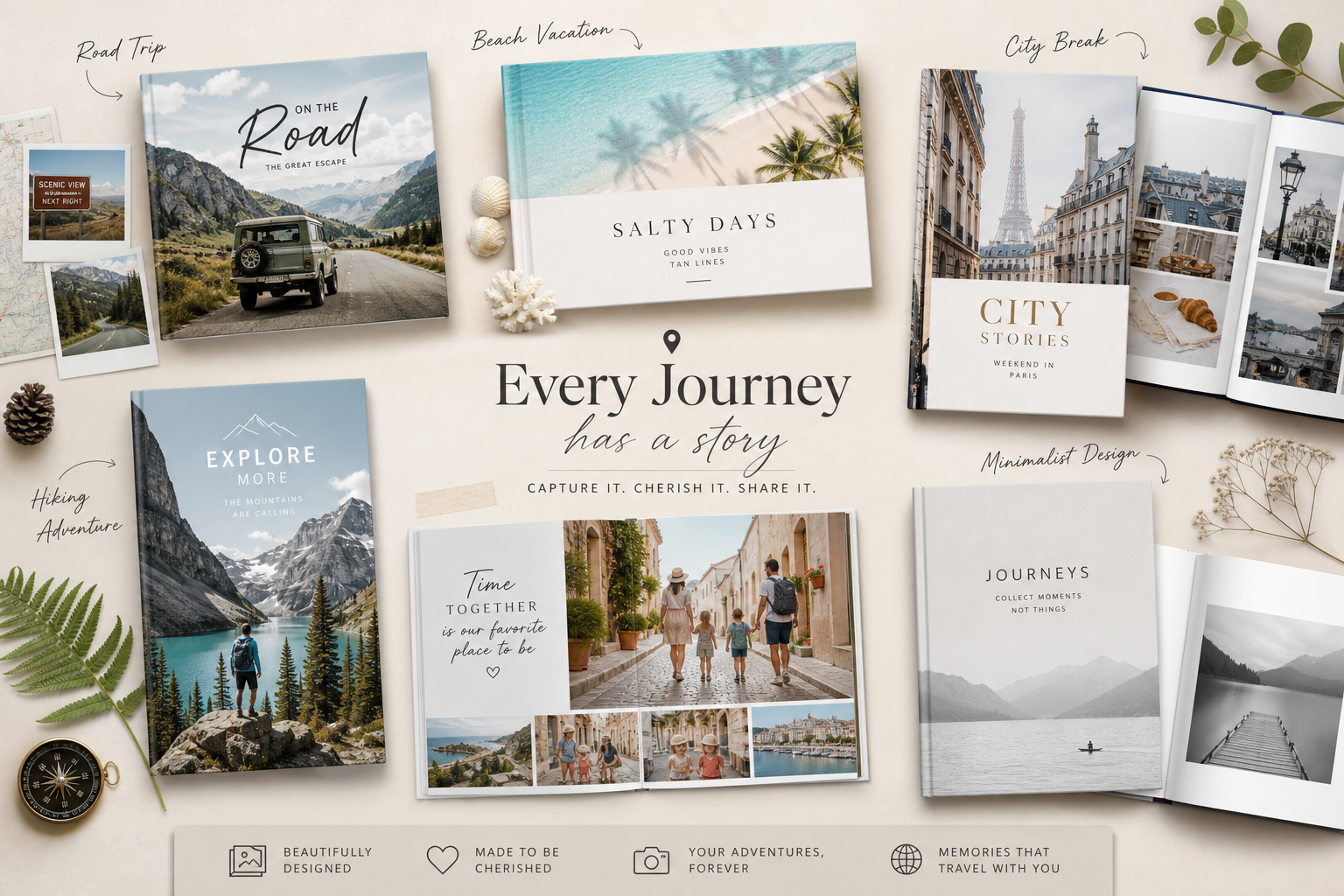
Build your pages around the route itself. Include maps, roadside stops, motel signs, playlists, petrol station coffee moments, and landscapes from the window.
A road trip book feels alive when it includes both the epic scenery and the small moments in transit.
2. The city break book
Perfect for Paris, Rome, Lisbon, Tokyo, or New York. Focus on street scenes, cafés, architecture, transport, markets, and evening light.
A clean, magazine-like design works especially well here.
3. The beach escape book
Use airy layouts, soft colors, and plenty of white space. Include ocean views, details like sandals in the sand, local seafood, sunset dinners, and candid relaxation shots.
This style benefits from calm pacing and full-page imagery.
4. The hiking or adventure book
This is ideal for mountain trips, safaris, campervan holidays, and outdoor expeditions. Include elevation milestones, route maps, weather changes, and hard-earned summit photos.
Action shots plus landscape spreads create a great balance.
5. The honeymoon photo book
Blend romance with storytelling. Feature meaningful details like handwritten vows, shared meals, scenic viewpoints, hotel corners, and portraits together.
Elegant typography and premium finishes can make this feel especially timeless.
6. The family vacation memory book
Include a mix of portraits, candid laughs, group shots, travel mishaps, and kids’ perspectives. This style works best when it feels joyful rather than too perfect.
A family travel book should preserve personality, not just polished poses.
7. The food-focused travel book
Build the story around taste. Include restaurant exteriors, menus, market stalls, local specialties, coffee cups, table details, and ingredients.
This idea is fantastic for Italy, Japan, Thailand, France, or anywhere food shaped the journey.
8. The hidden gems collection
Instead of famous landmarks, focus on the places you almost missed: the alley café, the empty beach, the tiny museum, the quiet sunrise trail.
This makes your book feel original and deeply personal.
9. The “one trip, one color palette” book
Choose a visual direction based on mood and color. For example:
terracotta and warm neutrals for desert travel
lush greens for rainforest adventures
blues and whites for Mediterranean holidays
moody greys for Nordic escapes
This creates a designer feel without needing complex layouts.
10. The tickets, maps, and memories book
Combine photos with visual memorabilia such as:
boarding passes
museum tickets
handwritten notes
route screenshots
postcards
receipts from special meals
These details give your book texture and authenticity.
11. The year of travel book
If you traveled multiple times in one year, create one book with seasonal chapters. This is ideal for couples, families, or frequent travelers who want one polished annual keepsake.
12. The “best of the trip” coffee-table book
Instead of documenting everything, curate only the strongest images. Think fewer pages, bigger visuals, and a premium editorial style.
This is excellent if you want a luxurious, gift-worthy book rather than a documentary record.
Photo layout ideas that instantly elevate your book
Design matters just as much as your photo selection. The best competitor content often shows examples, but rarely explains why certain layouts work. Here are the page structures that consistently create a more premium result.
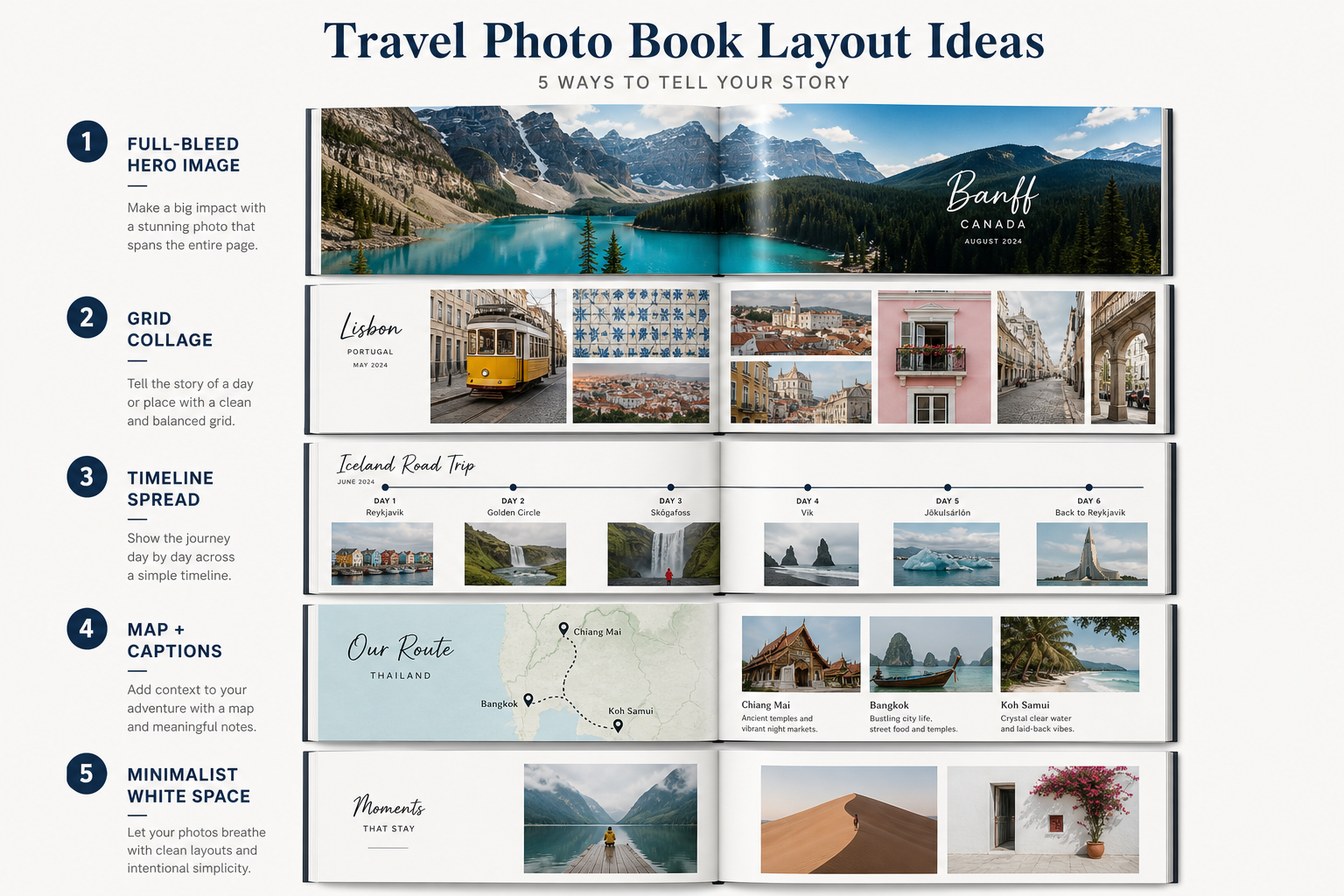
Full-bleed hero spreads
Use these for your strongest images:
mountain panoramas
skyline views
beach sunsets
iconic architecture
emotionally powerful candid shots
One large image creates impact and gives the eye room to breathe.
Clean two-photo spreads
A left-right pairing is perfect when two photos speak to each other, such as:
wide scene + close-up detail
portrait + location
day + night version of the same place
This layout feels sophisticated and balanced.
Grid collages
Great for:
food moments
markets
behind-the-scenes shots
day recaps
fun candid sequences
To avoid clutter, keep consistent spacing and avoid mixing too many unrelated image tones.
Timeline or chapter-opening pages
Use these for transitions. A chapter page can include:
destination name
dates
a short memory
a small map
one signature image
This adds structure and helps the book feel intentional.
White-space-driven minimalist pages
Sometimes one small photo with plenty of margin says more than a packed collage. This works especially well in luxury travel books, romantic trips, or reflective journeys.
How to choose photos without getting overwhelmed
This is where most people get stuck. You might have 800, 2,000, or even 5,000 trip photos. The solution is not to review them endlessly. It’s to filter strategically.
Use the 4-bucket method
Sort your photos into four categories:
Bucket | What goes in it | Purpose |
|---|---|---|
Hero shots | Your best, most striking images | Full-page spreads and cover options |
Story shots | Photos that show progression or context | Narrative flow |
Detail shots | Food, signs, textures, objects | Atmosphere and variety |
People moments | Portraits, candid laughs, interactions | Emotional connection |
Once you do this, the layout becomes easier because each page has a role.
Follow the highlight ratio
A strong travel photo book does not need every image. A good rule is:
20% hero shots
50% story shots
20% people moments
10% detail shots
This keeps the pacing interesting.
Remove repetition
If you have 17 photos of the same cathedral from slightly different angles, keep one or two. Repetition weakens impact.
Photo9 helps solve this pain point with AI-powered layout suggestions and automatic arrangement, so you spend less time sorting and more time refining the story.
Design tips that make a travel photo book look professionally made
Choose one font pairing
Use one heading font and one body font at most. Too many type styles make the book feel amateur.
Keep captions short and human
The best captions are not formal descriptions. They are specific memory triggers.
Examples:
“The café we went back to three mornings in a row”
“Caught the last light before the storm”
“Best pasta of the trip, maybe of our lives”
Let some pages stay simple
Not every page needs text, graphics, or multiple images. Variation is what creates rhythm.
Match the format to the trip
Different trips work better in different formats:
Trip type | Best format style | Why |
|---|---|---|
Safari or landscapes | Large hardcover | Best for panoramic impact |
Weekend city break | Compact softcover | Stylish and easy to share |
Honeymoon | Premium layflat or hardcover | Elegant and gift-worthy |
Family holiday | Durable hardcover | Great for frequent browsing |
Multi-trip yearbook | Medium or large book | Fits chapters well |
If you want a polished finish with durability and a more premium feel, a hard cover photo book is often the best choice for travel memories you plan to revisit for years.
Use color intentionally
If your trip photos vary wildly in lighting and tone, subtle editing can create cohesion. You don’t need to over-filter - just aim for balance in warmth, brightness, and contrast.
Make the cover say something
Avoid generic titles like “Vacation 2025” if you can be more evocative.
Better examples:
Northern Roads
Summer in Sicily
Ten Days in Japan
Coastlines & Quiet Mornings
Our Honeymoon in Greece
Mistakes to avoid when creating a travel photo book
Trying to include everything
A photo book is not an archive. It is a curated story.
Overcrowding pages
If every page is packed, nothing stands out.
Ignoring the emotional arc
The best books have movement: anticipation, discovery, quiet moments, highlights, and reflection.
Using low-resolution images
A beautiful design cannot rescue poor image quality. Start with strong originals whenever possible.
Forgetting the people
Even if the scenery was stunning, the human moments are what often matter most later.
Leaving it unfinished in your camera roll
The biggest mistake is never making the book at all. Memories feel vivid now, but they fade faster than most people expect.
Why printed travel memories still matter
Digital photos are convenient, but physical keepsakes create a different kind of connection. A printed travel book is easier to revisit, easier to share with family, and far more meaningful as a gift.
It also turns passive storage into active remembrance. Instead of being one more folder in the cloud, your trip becomes part of your home.
"According to a 2025 survey by Shorr Packaging, 90% of American consumers are more likely to purchase from brands that offer sustainable packaging." - Source)
That matters because modern customers do not just want beautiful products. They want responsible ones too. Photo9 supports that expectation with sustainable materials, recyclable packaging, secure ordering, and local printing where possible to help reduce emissions.
Why create your travel photo book with Photo9
Photo9 is built for people who want premium results without design stress.
What makes Photo9 different
AI-generated layouts in seconds so you do not start from a blank page
No app required for easy creation straight from your browser
Cross-device access so you can start on your laptop and continue on your phone
Smart layout suggestions based on your photos
Simple customization with text, backgrounds, and personal edits
3D preview to review your book before ordering
Multiple formats and themes for travel, family, gifts, weddings, and more
Premium materials and print quality for a refined final result
Fast, reliable delivery
Secure payment
100% satisfaction guarantee
Local production when possible
FSC-certified materials and recyclable packaging
For busy travelers, parents, couples, students, and gift buyers, that combination is powerful. You get a professional result without needing professional design skills.
A simple structure you can copy today
If you want a ready-to-use formula, try this:
1. Cover
Trip title + one standout image
2. Opening spread
Map, dates, short introduction
3. Arrival pages
Transport, first impressions, establishing shots
4. Main chapters
Organized by day, place, or theme
5. Highlight spread
The best moment of the trip as a full-page feature
6. Detail pages
Food, objects, signs, textures, souvenirs
7. People pages
Portraits, candid laughs, shared moments
8. Final spread
Last sunset, departure, or reflection
This framework works for almost any kind of trip and keeps your book from feeling random.
Final thoughts: turn your trip into something lasting
The best travel photo book inspiration starts with one idea: your memories deserve better than disappearing into your phone.
Whether you want a stylish city-break album, a family holiday keepsake, a romantic honeymoon book, or a curated adventure story, the secret is not complicated design. It is clear storytelling, thoughtful photo selection, and a layout that gives your memories room to shine.
Photo9 makes that process dramatically easier. With AI-powered design, smart suggestions, flexible customization, premium print quality, and a smooth online experience, you can create a travel photo book that looks professionally designed without spending hours building it.
If you’re ready to transform your trip photos into something meaningful, start by exploring Photo9’s photo books and create a keepsake you’ll actually want to open again and again.